Items
Class
Text
-
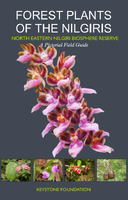 Forest Plants of the Nilgiris- North eastern Nilgiri Biosphere Reserve The North Eastern part of the Nilgiri Biosphere Reserve(NBR), has a wide variation of flora ranging from the dry decides, riparian forest and grassland. the fourth in a part of series, this field guide covers the dominant plants of this zone.
 -
 wildlife transect Methodology for wildlife movement data collection
 -
 Roadkill monitoring Methodology for roadkill monitoring data collection
 -
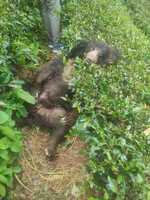 Animals postmortem Datasheets for wild animals postmortem
 -
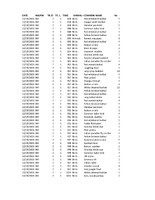 Wildlife site monitoring Datasheets for site monitoring in spring and waterholes
 -
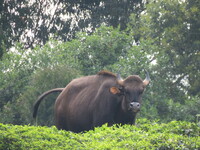 Gaur herd composition Datasheets for Indian gaur herd composition data collection.
 -
 Rescue and Rehab This report will gives you the details about Rescue and rehab work in the nilgiris .
 -
 Bird list _ Sigur and Pillur Bird list and local names from Sigur and Pillur. Developed by Sandhya Selvaraju (Intern) with the help of Asish, Nithya, Rajendran.
 -
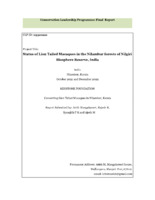 Final Project Reports for CLP and Rufford; Lion tailed macaque project Final project report shared with Conservation Leadership Programme (CLP) and Rufford foundation. Lion tailed macaque project in Nilambur.
 -
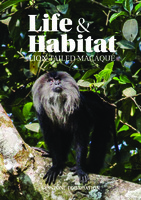 Life & Habitat of Lion Tailed Macaque The document provides an overview of the lion-tailed macaque, a primate endemic to the Western Ghats of India, specifically found in Kerala, Karnataka, and Tamil Nadu. It describes their physical characteristics, such as their distinctive tufted tails and black fur, and outlines their habitat preferences, which include tropical evergreen and monsoon forests at higher elevations. The document highlights their diet, primarily consisting of fruits, and their social structure, where groups typically consist of multiple females and a few males, with one dominant male. It also discusses their reproductive habits, the threats they face from habitat fragmentation and human interaction, and their crucial role in seed dispersal within their ecosystem. The document emphasizes the importance of not feeding wildlife to prevent negative impacts on their behavior and survival.
 -
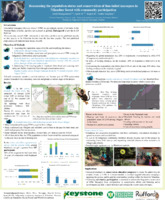 Lion tailed macaque project poster The document discusses the endangered status of lion-tailed macaques in the Western Ghats of India, highlighting a significant lack of recent data on their population in the Nilambur forests. The study aimed to assess the current population, identify threats, and engage local communities in conservation efforts. Through surveys and interviews, researchers found that local awareness of the macaques has improved, with many community members recalling past hunting practices that have ceased. The study identified ten distinct troops of macaques and emphasized the need for ongoing conservation education and community involvement to ensure the species' survival, addressing threats such as habitat loss and road safety issues. Poster presented at ICCB 2023 conference. The poster is made as an output for Lion tailed macaque (LTM) project in Nilambur.
 -
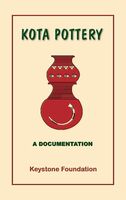 Kota Pottery Kota pottery, a traditional craft of the Kota community in the Nilgiris, Tamil Nadu, is a unique art form primarily practiced by women. The Kotas reside in seven villages, including Kilkotagiri and Gudalur, with a population that has historically been small, estimated at around 1,200 individuals. This community has long engaged in various trades such as blacksmithing, carpentry, and pottery, with women specifically responsible for crafting pottery—a rarity in India where this skill is typically male-dominated.
 -
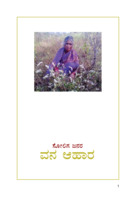 Wild food Kanada Book_Sholiga janavana aahara This booklet, fourth in the series, documents the indigenous knowledge of the sholiga communities in the Nilgiri Biosphere Reserve. This book is about food from the forest.
 -
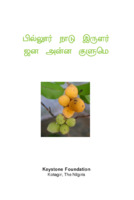 Irula Wild food-pillur book final with Index This booklet, the third in the series , documents the indigenous knowledge of communities in the Nilgiri Biosphere Reserve. The current publication contains the wild food plants of the Irula of the Pillur region.
 -
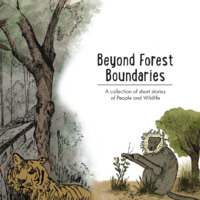 Beyond forest boundaries_final version_nov2021 The document presents a series of narratives about human encounters with wildlife in a village setting. It recounts various incidents, such as a family dealing with a sloth bear that intrudes into their home, a girl encountering gaurs while heading to a temple, and a community's fascination with a rare black monkey known as the Nilgiri Langur. Other stories include a woman facing wild boars attracted by garbage, a man rescuing an injured leopard, and a farmer struggling with mongooses stealing her chickens. These tales highlight the challenges and interactions between humans and wild animals, emphasizing the need for coexistence and understanding of wildlife behavior in rural areas. A collection of short stories of people and wildlife.
 -
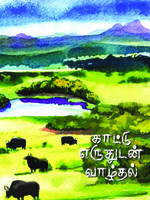 Living with Gaur_Tamil
-
 Annual Report _2021-2022 This resource contains an overview of activities taken up during the course of FY 2021-22 at Keystone Foundation, inclusive of programmatic activities, finances and updates from the field centres
 -
 Annual Report_2008 This resource contains an overview of activities taken up during the course of FY 2008 at Keystone Foundation, inclusive of programmatic activities, finances and updates from the field centers.
 -
 Annual Report_2006 This resource contains an overview of activities taken up during the course of FY 2006 at Keystone Foundation, inclusive of programmatic activities, finances and updates from the field centers.
 -
 Tree Fall Gap_(Organizational Structure) The document outlines the mission and organizational structure of the Keystone Foundation, which focuses on eco-development initiatives in the Nilgiri Biosphere Reserve, engaging with indigenous communities to enhance their livelihoods and environmental sustainability. Established in 1993, the foundation has developed various programs centered on natural resource management, organic farming, and cultural preservation, while promoting fair trade and community-based enterprises. It emphasizes participatory approaches, interdisciplinary collaboration, and the importance of indigenous knowledge, aiming to empower local populations and influence policy for better governance. The document also highlights the foundation's partnerships, achievements, and future goals, including the establishment of a producer company to further support local economies.
 -
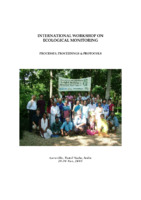 Ecological Monitoring Workshop_Auroville_Nov_05 The document discusses the Soligas, an indigenous tribal community residing in the Biligiri Rangan Hills (BRT), who traditionally engaged in hunting, cultivation, and the collection of non-timber forest products (NTFPs). With the establishment of the BRT as a wildlife sanctuary, the Soligas retained exclusive rights to extract NTFPs through a cooperative called LAMPS. The document highlights sustainable harvesting practices for various tree species, emphasizing the importance of proper techniques to prevent over-exploitation and ensure the longevity of resources. It also addresses the economic contributions of lichen collection to the Soligas' income and suggests community-based monitoring protocols to enhance sustainable practices. Additionally, it touches on the ecological implications of harvesting methods and the need for adaptive management strategies to balance resource use with conservation efforts.
 -
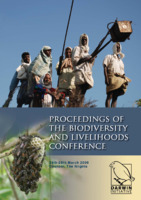 Book on proceedings of the biodiversity and livelihoods conference_ march 2009
-
 The Little Things That Run the World
-
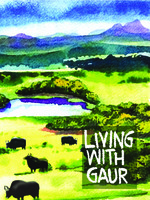 Living with Gaur
-
 Keystone Handbook on Honey Hunting